

How to scale a Shopify store with Meta Ads in 2026

Updated at
19.11.2026
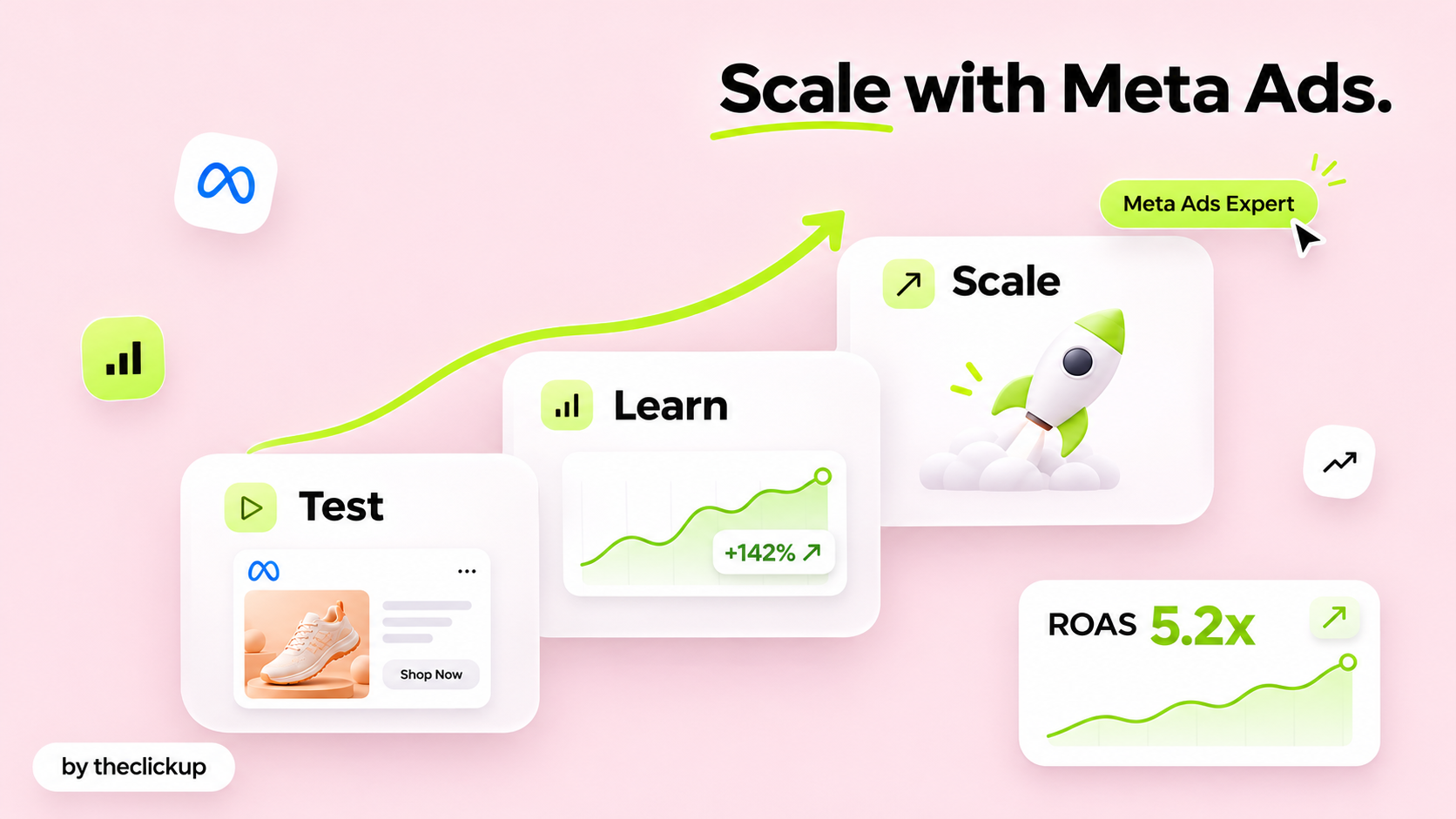
Scaling is not raising the budget. It is raising the budget only when the numbers say the next dollar will come back.
This guide covers how to scale a Shopify store with Meta Ads in 2026: the signals that say scale, the three levers that actually move results, the traps that burn budget, and a weekly routine that keeps the growth going.


Scaling with Meta Ads: the short answer
Scale when three things are true at the same time: the cost per purchase has been steady for at least two weeks, the creative is still fresh (frequency under 3), and the landing page converts. Then raise the budget 20-30% at a time, never double it overnight, and add one new creative every week so the account never runs out of fresh ads. If any of the three is not true, fix that first - more budget on a tired creative or a leaking landing page just buys the same sales at a worse price.
Most stores scale too early and too fast. They see one good week, double the budget, and watch the cost per purchase climb for a month. The sections below give you the numbers to watch and the order to scale in, so the growth sticks.
The scale signals at a glance
| The signal | Scale or stop? | What to do |
| Cost per purchase steady 2 weeks | Scale | Raise the budget 20-30% and watch it for a week |
| Frequency climbing past 3 | Do not scale | The same people see the same ad too often - add new creative first |
| Creative is 4+ weeks old | Do not scale | Fatigue is coming even if the numbers look fine today |
| Landing page converts under 2% | Do not scale | Fix the page first - ads cannot fix a page that does not sell |
| One ad set carries all sales | Scale carefully | Build a second ad set before raising the budget on the first |
| New creative beats the old one | Scale | Move budget to the winner and keep testing the next one |
The three levers that actually scale a store
Budget is the last lever, not the first. These three move results before a dollar is added.
1. Creative: the ad is the targeting now
Meta does the targeting; the creative does the selling. A store that scales has a pipeline, not one lucky ad: new hooks every week, video and image and carousel in rotation, and customer proof in the ad itself. Our creative testing guide covers how to test one variable at a time, and how to write Meta Ads that convert covers the hook-proof-offer structure. The rule is simple: if you have not made a new ad this week, you are not scaling - you are waiting for the old one to die.
2. Audiences: broaden only when the narrow one works
Start with the people who already know the store: site visitors, cart abandoners, past buyers. When those convert steadily, broaden to lookalikes and then to broad interest targeting - in that order. Jumping straight to broad targeting with an unproven offer is how budgets disappear. Our retargeting guide covers the audience order, and the Meta Ads vs Google Ads guide covers when Meta is the right channel at all: Meta creates demand, Google catches it.
3. The landing page: where scale actually happens
Ads bring the buyer; the page closes the sale. Before you scale, the product page needs the same discipline as the ad: one product, one price, reviews, and one clear action - no competing buttons, no slow images. Our speed optimisation guide covers the technical half, and the Shopify redesign checklist covers the page itself. A store that scales on a leaking page just pays Meta to send buyers to a page that does not sell - fix the page, then raise the budget.
When NOT to scale (the traps)
Do not scale when the numbers look good for the wrong reason. A sale weekend, a viral post or one big buyer can make a week look like growth - and doubling the budget on a spike is how a good month turns into a bad one. Do not scale when the cost per purchase is rising while you raise the budget: that is the account telling you the audience is exhausted or the creative is tired. And do not scale when the store cannot fulfil: ads that sell products the store cannot ship on time buy refunds and bad reviews, not growth.
The other trap is scaling the wrong metric. Cost per click falling means nothing if cost per purchase is rising; more traffic means nothing if fewer people buy. The metric that decides scale is cost per purchase against the margin on the product - everything else is noise. Meta Ads management typically runs $1,000-$5,000 a month or 10-20% of ad spend, as reported by US agencies, and a good agency will tell you not to scale before they will take the extra budget.
The weekly scaling routine
Scaling is a routine, not an event. Every week:
- Monday - read the numbers: cost per purchase, frequency, and the age of the winning creative. If cost per purchase has been steady for two weeks, the account is ready to scale.
- Tuesday - ship one new creative: a new hook on the winning angle, not a new angle. The winner keeps running while the new one tests.
- Wednesday - raise the budget 20-30%: on the winning ad set only, never on all of them at once. One change, one measurement.
- Thursday - check the landing page: conversion rate, page speed, and whether the offer in the ad matches the offer on the page. If they do not match, fix the page before Friday.
- Friday - kill or keep: the new creative either beats the old one or it does not. Kill the loser, move its budget to the winner, and plan next week - with the store and the ads run by one team, so the page and the ad change together.
Repeat for a month and the store grows in steps, not spikes - and steps are the growth that stays.
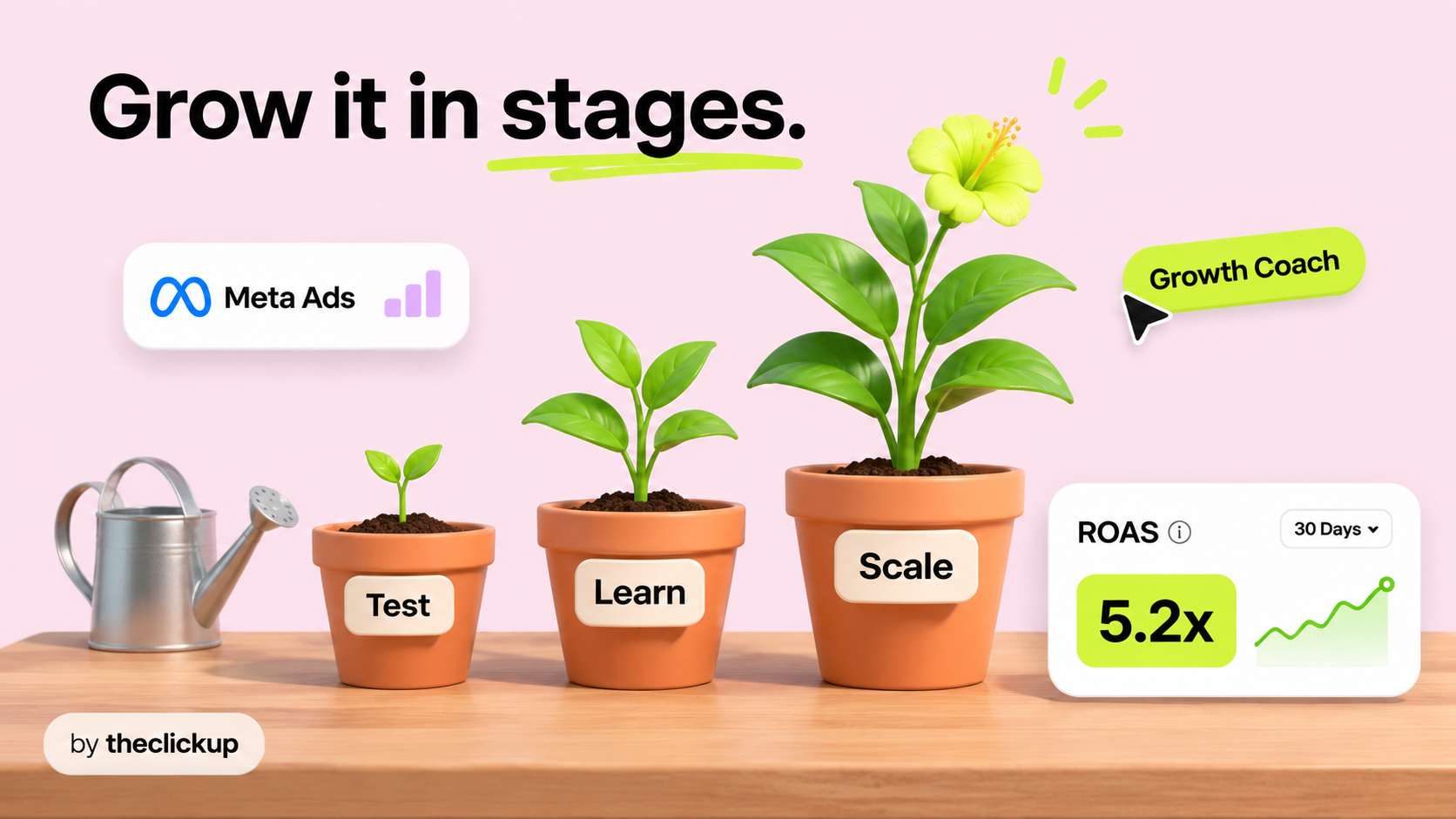
Spending more and getting less? Check the fatigue signs in section 4 first - or ask us to audit the account before you spend.
The verdict: scale the system, not the spend
Stores that scale with Meta Ads do not have a bigger budget - they have a better system: fresh creative every week, audiences broadened in order, a landing page that converts, and a budget that rises 20-30% at a time only when the numbers say so. Raise the budget before the system is ready and you buy the same sales at a worse price. Build the system first, then the spend follows it. If you want the system built for your store, our Meta Ads management cost guide covers what that costs.
FAQ
How fast should I scale Meta Ads budget?
Raise the budget 20-30% at a time, once a week at most, and only when cost per purchase has been steady for two weeks. Doubling the budget overnight usually makes cost per purchase climb, because Meta needs time to find more buyers at the same price.
What is a good cost per purchase for a Shopify store?
It depends on the product margin: a $30 product and a $300 product cannot share a target. The rule is that cost per purchase must leave room for the product cost, shipping and the ad spend itself - if it does not, fix the offer or the page before you scale.
How do I know my Meta creative is fatigued?
Frequency climbing past 3, cost per purchase rising while nothing else changed, and the same ad running for 4+ weeks are the signs. Add a new hook on the winning angle and let it test against the old one before you raise any budget.
Should I scale with broad or interest targeting?
Start narrow - retargeting and lookalikes of buyers - and broaden only when the narrow audiences convert steadily. Broad targeting works when the creative is strong and the offer is proven; it burns budget fast when either one is weak.
Read more

 advantage

 Book a call

Fill out the form
or brief with questions



 LinkedIn
 Instagram
Welcome to The ClickUp privacy notice.
The ClickUp respects your privacy and is committed to protecting your personal data. This privacy notice will inform you as to how we look after your personal data when you visit our website (regardless of where you visit it from) and other sites we own and operate. And tell you about your privacy rights and how the law protects you.
We may change the privacy policy from time to time to reflect changes to the products and services that we provide and how we process your personal data.
We will not share your information with any third party outside of our organization, other than as necessary to fulfil your request if any."
INFORMATION WE COLLECTWhen you visit our website, our servers may automatically log the standard data provided by your web browser. This data is considered “non-identifying information”, as it does not personally identify you on its own. It may include:
- Your computer’s Internet Protocol (IP) address;
- Your browser type and version;
- The pages you visit;
- The time and date of your visi;
- The time spent on each page;
We may ask for personal information, such as your name and email address. This data is considered “identifying information”, as it can personally identify you. We only request personal information relevant to providing you with a service, and only use it to help provide or improve this service.
We collect information by fair and lawful means, with your knowledge and consent. We also let you know why we’re collecting it and how it will be used. You are free to refuse our request for this information, with the understanding that we may be unable to provide you with some of your desired services without it.
We will only process personal data and communicate with you if:
1. You have given us consent to the processing of your personal data and communicating for one or more specific purposes i.e. requesting products or services from us, downloading material or information from our website or submitting a contact us form.
2. Performance of a contract
3. Where we have a legitimate interest for contacting you in relation to our products and services
DATA PROCESSING AND STORAGEWe only retain personal information for as long as necessary to provide a service, or to improve our services in future. While we retain this data, we will protect it within commercially acceptable means to prevent loss and theft, as well as unauthorised access, disclosure, copying, use or modification. That said, we advise that no method of electronic transmission or storage is 100% secure, and cannot guarantee absolute data security.
Rights and choices of individuals:
- See what data we have about you, if any;
- Change/correct any data we have about you;
- Have us delete any data we have about you;
- See what security measures we apply to your data;
- Express any concern you have about our use of your data;
You may opt out of any future contacts from us at any time. You can do the following at any time by contacting us via the email address given on our website: theclickup.com
Got questions or want to discuss a project?


