

Shopify Plus vs WooCommerce for B2B stores in 2026

Updated at
19.11.2026
A B2B store is not a B2C store with a bigger cart. Wholesale buyers order in bulk, pay on net terms, need custom pricing per customer, and reorder the same list every month - and the platform has to handle all of that without a workaround.
This guide covers Shopify Plus vs WooCommerce for B2B stores in 2026: what a B2B store actually needs, how the two platforms handle wholesale pricing, catalogs and checkout, what each one costs in practice, and how to decide in one afternoon.


Shopify Plus vs WooCommerce for B2B stores: the short answer
Shopify Plus wins for a B2B store when the business needs wholesale to work out of the box: company profiles, custom catalogs and pricing per customer, net payment terms, bulk ordering and a checkout the buyer cannot break. WooCommerce wins when the budget is tight, the team can maintain a WordPress site, and the B2B requirements are simple enough for plugins to cover - one price list, one wholesale tier, manual invoicing. The deciding question is not which platform is better. It is who places the orders, who maintains the store, and what the checkout must do - because a B2B store that gets those three wrong pays for it on every order.
The numbers frame the choice. Shopify plans run $39-$399 a month, and Shopify Plus starts from $2,300 a month, as listed by Shopify, and the Basic plan charges 2.9% + 30 cents per transaction with Shopify Payments in the US, as listed by Shopify. WooCommerce itself is a free plugin, but the store still needs hosting, a theme and plugins - US agencies typically quote hosting at $10-$100 a month for a small WooCommerce store, as reported by US agencies, and the plugins that add B2B features are usually paid yearly. A premium theme costs $250-$380 one time on the Shopify Theme Store, as listed there. US agency developers typically charge $150-$300 an hour, as reported on Clutch - and a B2B build needs more of those hours in pricing, catalogs and checkout setup than a simple catalogue store. Our Shopify Plus vs Shopify comparison covers the Plus upgrade, and Shopify Plus pricing explained covers what the fee buys - this guide covers the B2B decision itself.
What a B2B store needs, and how the two platforms handle it
| What the B2B store needs | Shopify Plus | WooCommerce |
| Wholesale pricing per customer | Shopify Plus gives each company its own catalog and price list, built in | WooCommerce needs a B2B plugin for per-customer pricing, and the plugin has to stay compatible with every update |
| Net terms and invoicing | Shopify Plus supports net payment terms and draft orders for B2B buyers | WooCommerce handles invoicing through plugins or manual orders - workable, but the store owner becomes the billing department |
| Bulk and repeat ordering | Shopify Plus bulk ordering and quick reorder are part of the B2B setup | WooCommerce repeat ordering needs a plugin, and the reorder flow has to be built and tested for each store |
| Checkout control | Shopify Plus checkout can be customised for B2B: purchase orders, tax exemption, minimums | WooCommerce checkout is fully customisable, but every customisation is code the team has to maintain |
| Hosting and maintenance | Shopify hosts the store, handles security and updates, and stays up | WooCommerce hosting, security, backups and updates are the store owner’s job - or an agency retainer |
| Total cost in practice | Plus starts from $2,300 a month, as listed by Shopify, plus the build | WooCommerce starts cheap and grows with hosting, plugins and maintenance - the bill is smaller but never stops |
Three things that decide whether Plus or WooCommerce is right
Three things decide whether Shopify Plus or WooCommerce is right for a B2B store. Everything else is decoration.
1. Who places the orders
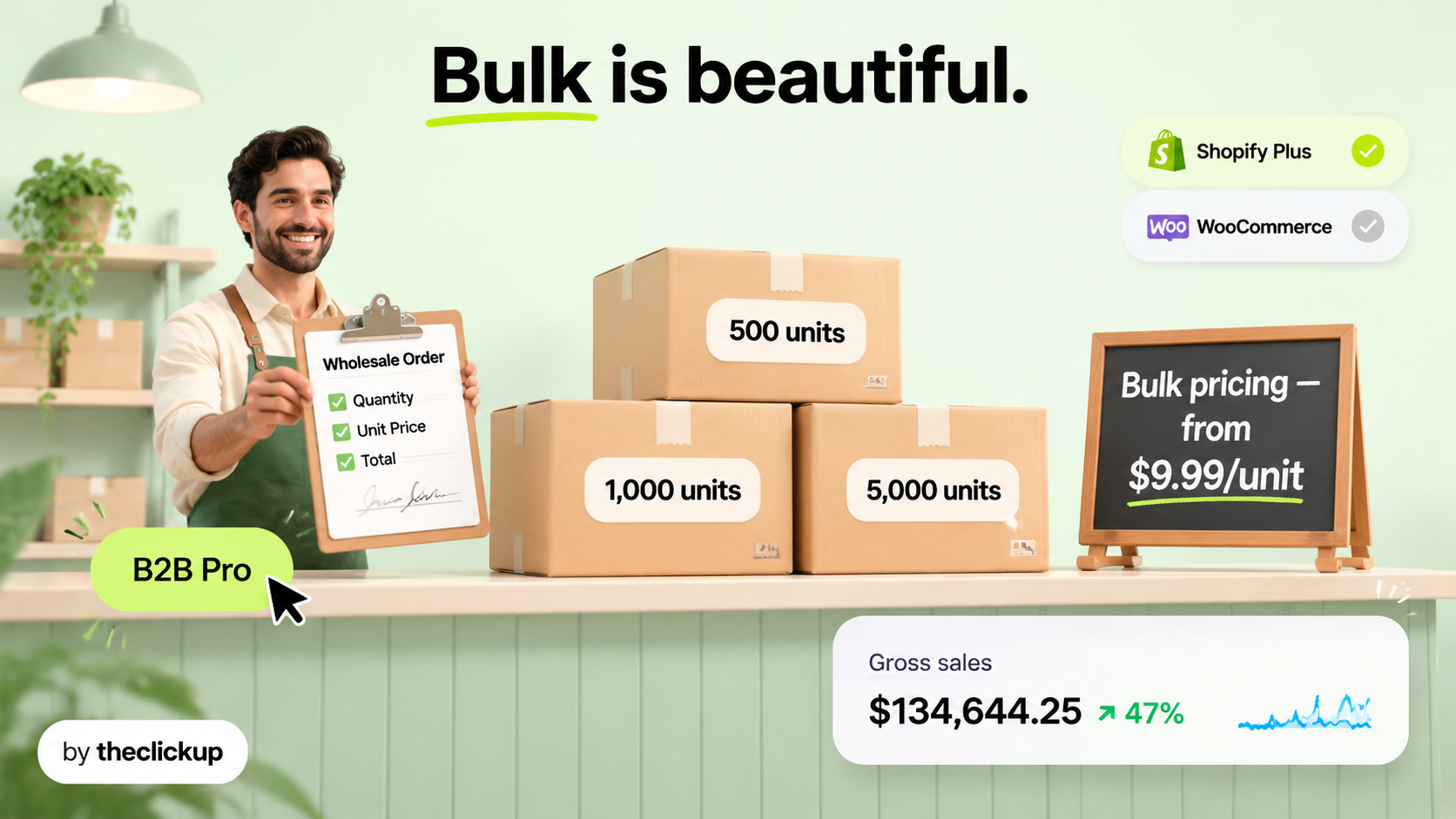
A B2B buyer is not a shopper. They order the same list every month, they order in bulk, and they expect their price - not the public price. If the store has ten wholesale customers with ten different price lists, Shopify Plus handles that natively: each company gets its own catalog and its own prices. On WooCommerce the same thing needs a plugin, and the plugin has to be configured for every customer and tested after every update. Ask who the buyers are before choosing the platform: a store with a handful of wholesale customers and one price list can run on WooCommerce, but a store with dozens of buyers and per-customer pricing needs Plus. Our Shopify vs WooCommerce comparison covers the same question for B2C stores - for B2B, add the price-list question first.
2. Who maintains the store
Shopify Plus is hosted, secured and updated by Shopify. WooCommerce is hosted, secured and updated by the store owner - or by an agency on retainer. A B2B store that goes down during an ordering window loses the orders that were supposed to arrive that day, and a wholesale buyer who cannot place an order calls a competitor. If the business has a developer on staff, WooCommerce is a fair choice. If it does not, the maintenance cost of WooCommerce - hosting, security, backups, plugin updates, the occasional broken update - quietly becomes a monthly bill that nobody budgeted for. The Shopify service covers the hosted route, and how much a Shopify store costs covers the full price picture for both routes.
3. What the checkout must do
A B2B checkout has to do things a B2C checkout never does: accept a purchase order, apply net terms, show tax-exempt pricing, enforce a minimum order, and let a buyer reorder a saved list in one click. Shopify Plus builds most of that into its B2B checkout. WooCommerce can do all of it too - but each piece is a plugin or custom code, and each piece is a thing that can break. Before choosing, write down the five checkout steps the real buyers actually take, then check each one against the platform. The platform that covers the list with the least custom code is the right one. The redesign cost guide covers what a rebuild should include when the first version was built for the wrong checkout.
The three mistakes that cost a B2B store its launch
Most failed B2B launches come from three mistakes, and all three look like good decisions at the time:
Choosing on the B2C portfolio. An agency that builds beautiful consumer stores will build a beautiful B2B store - and miss the wholesale pricing, the net terms and the reorder flow entirely. A B2B store is judged by the buyer who places the same order every month, not by the visitor who browses once. Ask the agency to show a B2B store, and to place a bulk order on it, before you sign.
Underestimating the maintenance. WooCommerce looks free until the hosting, the security, the backups, the plugin renewals and the broken update arrive - and a B2B store cannot afford a week of downtime while a plugin is fixed. Budget the maintenance before launch, in money and in hours, or the store will be maintained by whoever is free on a Friday afternoon. Our Shopify vs Squarespace comparison covers the same trap on a smaller store - the platform is rarely the bottleneck, the maintenance plan is.
Ignoring the checkout until launch week. A B2B checkout that cannot take a purchase order, cannot apply net terms and cannot reorder a saved list will be discovered by the first real buyer - in front of the sales team. Test the checkout with a real buyer before launch: a bulk order, a net-terms order and a reorder of last month’s list. If any of the three fails, the store is not ready.
How to decide in one afternoon
Five checks, one afternoon, and you will know whether the store needs Plus or WooCommerce:
- How many wholesale customers, and how many price lists? One price list for a handful of buyers fits WooCommerce. Dozens of buyers with per-customer pricing needs Plus.
- Who maintains the store every month? A developer on staff can run WooCommerce. Nobody on staff means Shopify Plus, or a retainer that costs as much as the difference.
- Write down the five checkout steps your real buyers take. Then check each one against the platform. The one that covers the list with the least custom code wins.
- What does a reorder look like? A wholesale buyer reorders the same list every month. If the reorder takes more than one click, the platform is wrong for the business.
- Who owns the store after launch? Pricing, catalogs, orders, invoices - a B2B store needs an owner every week, not a one-time build. If nobody owns it, the first failed invoice stays broken until a buyer complains.
If any answer is weak, the platform choice is wrong - however good the demo looked. The right platform answers all five without hesitating.
Already selling wholesale on a B2C store and fighting the checkout? Check the three mistakes in section 4 first - or ask us to audit the store before you rebuild.
The verdict: Plus for real wholesale, WooCommerce for simple B2B
Shopify Plus vs WooCommerce for B2B stores in 2026 comes down to the buyers: if the store has many wholesale customers with per-customer pricing, net terms and bulk reorders, Plus is the right platform - it builds those features in, and the store stays up without a maintenance team. If the B2B requirements are simple - one price list, a handful of buyers, manual invoicing - and the team can maintain WordPress, WooCommerce is the cheaper route and a fair choice. Decide on the checkout list, the price lists and the maintenance plan, not on the demo. Launch with the checkout tested by a real buyer, and make sure the same team can run the Meta Ads that bring the buyers. If you want help with the decision, how to choose a Shopify agency in the USA covers the full vetting checklist, and Shopify Plus pricing explained covers what the Plus fee buys - and theclickup builds Shopify Plus stores for US B2B brands from Islamabad, Pakistan, alongside the Meta Ads that bring the buyers.
FAQ
How much does Shopify Plus cost for a B2B store in 2026?
Shopify Plus starts from $2,300 a month, as listed by Shopify, plus the build. The standard plans run $39-$399 a month, as listed by Shopify, but they do not include the B2B features - company profiles, custom catalogs, net terms - that a wholesale store needs. The build is a project, scoped per brief.
Can WooCommerce handle B2B wholesale?
Yes, with plugins: per-customer pricing, bulk ordering, net terms and invoicing are all available as WooCommerce plugins. The cost is the maintenance - hosting, security, backups, plugin renewals and compatibility testing after every update - and the store owner carries it, or pays an agency retainer to carry it.
Does Shopify Plus support net payment terms?
Yes. Shopify Plus B2B supports net payment terms, draft orders and purchase orders for wholesale buyers, alongside custom catalogs and pricing per company. That is the feature most B2B stores actually need, and the one the standard Shopify plans do not include.
What is the cheapest way to run a B2B store?
WooCommerce starts cheapest - the plugin is free, and US agencies typically quote hosting at $10-$100 a month for a small store, as reported by US agencies - but the plugins, the maintenance and the occasional broken update add up. The cheapest platform over three years is the one whose maintenance the team can actually do.
Read more

 advantage

 Book a call

Fill out the form
or brief with questions



 LinkedIn
 Instagram
Welcome to The ClickUp privacy notice.
The ClickUp respects your privacy and is committed to protecting your personal data. This privacy notice will inform you as to how we look after your personal data when you visit our website (regardless of where you visit it from) and other sites we own and operate. And tell you about your privacy rights and how the law protects you.
We may change the privacy policy from time to time to reflect changes to the products and services that we provide and how we process your personal data.
We will not share your information with any third party outside of our organization, other than as necessary to fulfil your request if any."
INFORMATION WE COLLECTWhen you visit our website, our servers may automatically log the standard data provided by your web browser. This data is considered “non-identifying information”, as it does not personally identify you on its own. It may include:
- Your computer’s Internet Protocol (IP) address;
- Your browser type and version;
- The pages you visit;
- The time and date of your visi;
- The time spent on each page;
We may ask for personal information, such as your name and email address. This data is considered “identifying information”, as it can personally identify you. We only request personal information relevant to providing you with a service, and only use it to help provide or improve this service.
We collect information by fair and lawful means, with your knowledge and consent. We also let you know why we’re collecting it and how it will be used. You are free to refuse our request for this information, with the understanding that we may be unable to provide you with some of your desired services without it.
We will only process personal data and communicate with you if:
1. You have given us consent to the processing of your personal data and communicating for one or more specific purposes i.e. requesting products or services from us, downloading material or information from our website or submitting a contact us form.
2. Performance of a contract
3. Where we have a legitimate interest for contacting you in relation to our products and services
DATA PROCESSING AND STORAGEWe only retain personal information for as long as necessary to provide a service, or to improve our services in future. While we retain this data, we will protect it within commercially acceptable means to prevent loss and theft, as well as unauthorised access, disclosure, copying, use or modification. That said, we advise that no method of electronic transmission or storage is 100% secure, and cannot guarantee absolute data security.
Rights and choices of individuals:
- See what data we have about you, if any;
- Change/correct any data we have about you;
- Have us delete any data we have about you;
- See what security measures we apply to your data;
- Express any concern you have about our use of your data;
You may opt out of any future contacts from us at any time. You can do the following at any time by contacting us via the email address given on our website: theclickup.com
Got questions or want to discuss a project?


