

Shopify + Meta Ads funnel: from click to customer, for fintech and ecommerce

Updated at
18.11.2026
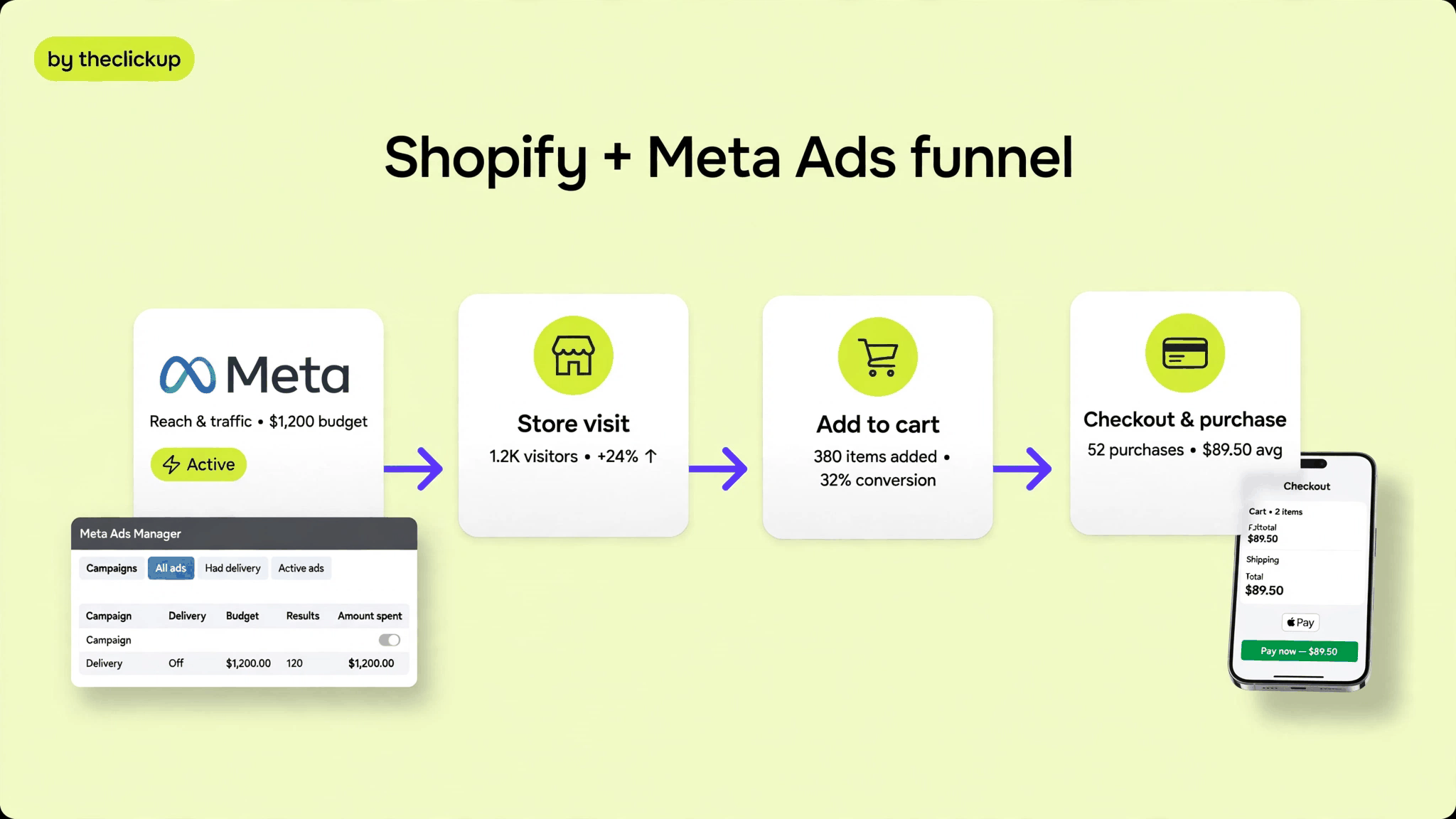
Meta Ads can fill a Shopify store with traffic — or burn the budget in a week. The difference is rarely the ads themselves. It is the funnel underneath them: the landing page, the tracking, the retargeting and the follow-up that turn a click into a customer.
This guide shows how Shopify and Meta Ads work as one system — what each stage of the funnel needs from the store and from the ads, where most funnels break, and how to budget the whole thing in the right order.


The funnel, in one picture
A funnel is not a diagram, it is a promise kept at every step. The ad promises something, the page delivers it, the checkout makes it easy, and the follow-up brings the buyer back. When one step breaks the promise, the whole funnel leaks — and the ads get blamed for a store problem.
- Awareness — the ad stops the scroll and names the problem in one line.
- Consideration — the landing page proves the claim with product, proof and price.
- Conversion — checkout is fast, obvious and trusted, on mobile first.
- Retention — email and retargeting bring the buyer back for the second order.
- Tracking — Conversions API and proper events tell Meta who actually bought.
- Budget — test first, learn, then scale — never the other way round.
The practical takeaway: your funnel is not a Meta problem or a Shopify problem, it is one system. Fix the weakest step first and the same ad spend buys more — fix the wrong step and nothing changes.
The funnel, stage by stage
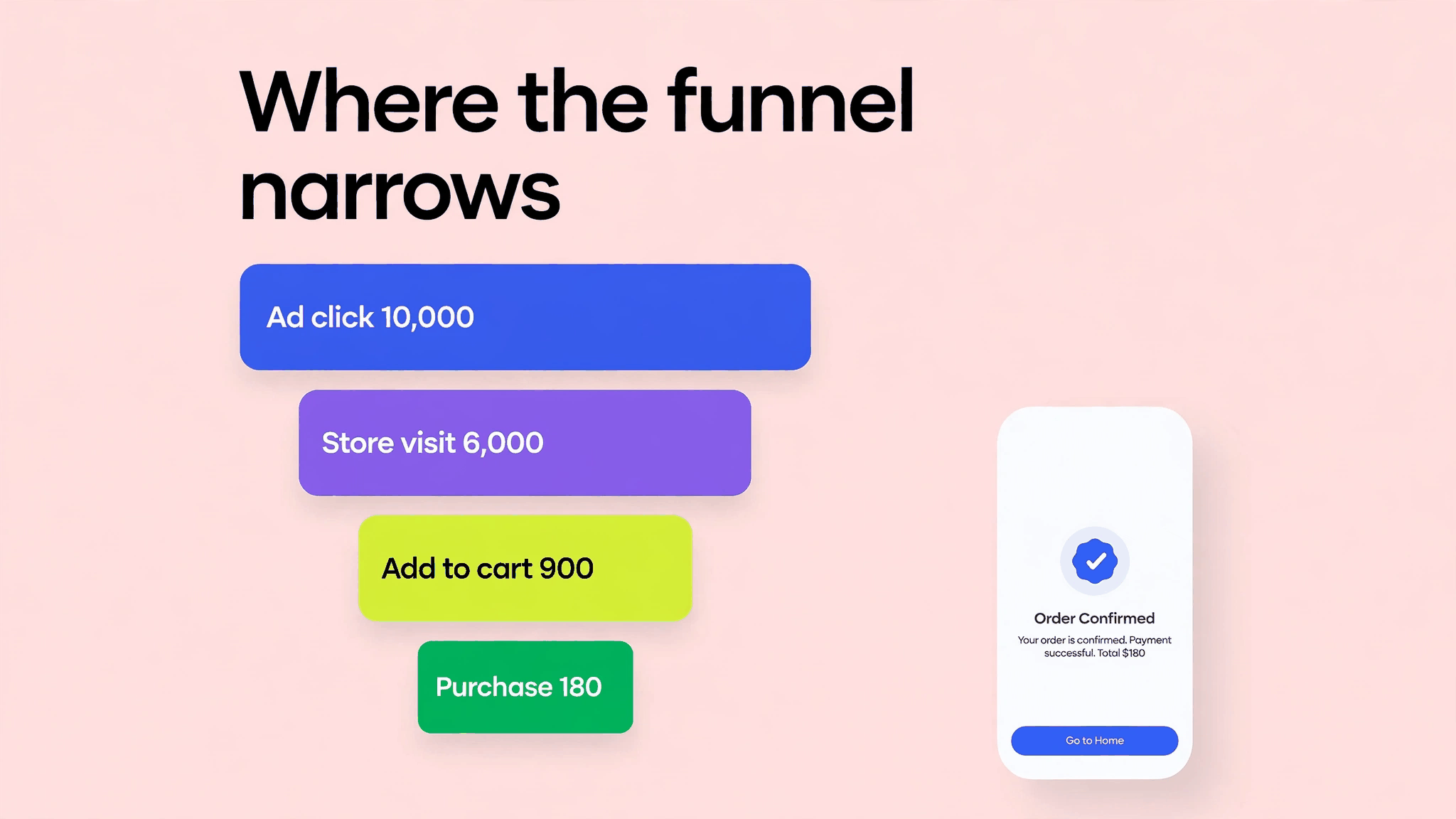
| Funnel stage | What the store must do | What the ads must do |
| Awareness | Fast page, clear hero, one promise | Broad creative that stops the scroll |
| Consideration | Proof, reviews and price on the page | Angles that match the landing page |
| Conversion | One-page checkout, Shop Pay, trust signals | Retargeting for cart abandoners |
| Retention | Post-purchase email and subscription offers | Loyalty and lookalike audiences |
| Tracking | Conversions API and clean events | Value-based audiences, not guesses |
| Measurement | One dashboard: ad spend vs store revenue | Weekly creative tests, kill the losers |
Where most funnels break
Three breaks cause most of the wasted spend we see — and all three sit between the ad and the store, not inside either one.
The ad promises what the page doesn’t deliver
An ad shows a price, a bundle or a benefit the landing page never mentions, and the visitor leaves in seconds. Every ad angle needs a matching landing page — same claim, same price, same image — or the click is wasted before the store gets a chance.
Tracking gaps starve the algorithm
Without Conversions API and proper events, Meta optimizes blind: it finds more clickers instead of more buyers. The store must send clean purchase events back, or the ads keep buying the wrong audience at full price.
Retargeting that never fires
Most stores spend everything on cold traffic and nothing on the people who already clicked. The cheapest conversions you will ever buy are the visitors who added to cart and left — if nobody follows up, a competitor will.
Shopify + Meta Ads for fintech: the extra steps
Fintech brands pay more for attention — 2026 industry data puts finance CPM at $28.40 on average, roughly double the $15.06 median across all brands (Revealbot / WordStream 2026, Triple Whale 2026). The funnel has to work harder: education before the pitch, proof before the signup, and compliance-checked creative that still converts.
That means longer funnels: a guide or calculator first, a signup second, and retargeting in between. Brands that send cold traffic straight to a signup form pay the finance premium and get ecommerce conversion rates. The extra steps are not optional — they are what makes the math work.
If you want the funnel planned around your numbers, see how we structure full-funnel campaigns on our Meta Ads services page — and how the store underneath is built on our Shopify store design & development page.
What to spend, and in what order
Budget by stage, not by hope. Four lines, in order:
- Testing — $1,000–$3,000 a month to learn which creative and audiences work. This is research spend, not profit spend.
- Learning — keep the winners running until the account has 50+ conversions a month; only then does Meta’s optimization work properly.
- Scaling — increase budgets on proven campaigns by 20% at a time, never all at once, or the learning resets.
- Retargeting — hold back 10–20% of budget for the people who clicked but did not convert; they are the cheapest conversions you will buy.
The most common budgeting mistake is starting with the scaling number and skipping the testing budget. A $5,000 month with untested creative loses to a $2,000 month with proven creative — the creative is the budget.
Not sure where your funnel leaks? Send us your store link and your ad account numbers — we will tell you which stage is losing the money, before we quote anything.
Final thoughts
Shopify and Meta Ads are not two purchases, they are one funnel. A store that converts makes every ad cheaper — median CPM $15.06 and median cost per lead $27.39 are starting points, not promises, and the store decides where your number lands.
Start with a testing budget, let the data pick the winners, and scale in steps. And fix the store before you scale the ads: the only number that matters is revenue per dollar of ad spend, and that number is made on the store, not in Ads Manager.
FAQ
Should I run Meta Ads to my Shopify store?
Yes — Meta is one of the best channels for Shopify stores, especially with Advantage+ shopping campaigns once you have 50+ monthly purchases. Pair it with a store that converts: see our Shopify store design & development page and our Meta Ads services page.
How much should I budget for the funnel, not just the ads?
Budget the funnel in four lines: $1,000–$3,000 a month for testing, then learning until 50+ conversions a month, then scale proven campaigns by 20% at a time, and hold back 10–20% for retargeting. The store build is a separate one-off budget — ads on a store that does not convert waste both.
Why do my Meta Ads get clicks but no sales?
Usually the funnel breaks after the click: the ad promises something the landing page does not deliver, checkout is slow or confusing, or tracking is broken so Meta optimizes for clicks instead of buyers. Fix the page and the tracking before raising the budget.
How long does it take to build a Shopify + Meta Ads funnel?
Expect two to four weeks before you can judge the ads: the first week is learning, the second is testing, and only then is the data stable enough to scale. A store build or redesign typically takes four to eight weeks before that, depending on catalog size and custom work.
Read more
 advantage

 Book a call

Fill out the form
or brief with questions



 LinkedIn
 Instagram
Welcome to The ClickUp privacy notice.
The ClickUp respects your privacy and is committed to protecting your personal data. This privacy notice will inform you as to how we look after your personal data when you visit our website (regardless of where you visit it from) and other sites we own and operate. And tell you about your privacy rights and how the law protects you.
We may change the privacy policy from time to time to reflect changes to the products and services that we provide and how we process your personal data.
We will not share your information with any third party outside of our organization, other than as necessary to fulfil your request if any."
INFORMATION WE COLLECTWhen you visit our website, our servers may automatically log the standard data provided by your web browser. This data is considered “non-identifying information”, as it does not personally identify you on its own. It may include:
- Your computer’s Internet Protocol (IP) address;
- Your browser type and version;
- The pages you visit;
- The time and date of your visi;
- The time spent on each page;
We may ask for personal information, such as your name and email address. This data is considered “identifying information”, as it can personally identify you. We only request personal information relevant to providing you with a service, and only use it to help provide or improve this service.
We collect information by fair and lawful means, with your knowledge and consent. We also let you know why we’re collecting it and how it will be used. You are free to refuse our request for this information, with the understanding that we may be unable to provide you with some of your desired services without it.
We will only process personal data and communicate with you if:
1. You have given us consent to the processing of your personal data and communicating for one or more specific purposes i.e. requesting products or services from us, downloading material or information from our website or submitting a contact us form.
2. Performance of a contract
3. Where we have a legitimate interest for contacting you in relation to our products and services
DATA PROCESSING AND STORAGEWe only retain personal information for as long as necessary to provide a service, or to improve our services in future. While we retain this data, we will protect it within commercially acceptable means to prevent loss and theft, as well as unauthorised access, disclosure, copying, use or modification. That said, we advise that no method of electronic transmission or storage is 100% secure, and cannot guarantee absolute data security.
Rights and choices of individuals:
- See what data we have about you, if any;
- Change/correct any data we have about you;
- Have us delete any data we have about you;
- See what security measures we apply to your data;
- Express any concern you have about our use of your data;
You may opt out of any future contacts from us at any time. You can do the following at any time by contacting us via the email address given on our website: theclickup.com
Got questions or want to discuss a project?


